Wednesday, December 31, 2014

Hurry Hurry Mary Dear by N.M. Bodecker, illustrated by Erik Blegvad


I was hoping to get this post out before winter officially started, but I am alas late, unlike Mary, the heroine of this wonderful book, so hoping to get it out before the New Year.

"Hurry, hurry, Mary dear 
fall is over, winter's here. 
Not a moment to be lost, 
in a minute we get frost! 
In an hour we get snow! 
Drift like houses! Ten below!" 

I've had this book for a long time. It is one the rare exceptions in which the writer and the illustrator are a perfect match but that's because they were close friends, who studied art together in Denmark, and came to the States around the same time, and collaborated here while both working as illustrators and writers. Also, they are both absolutely amazing; here's an article about Eric Blegvad and here's one about N.M. Bodecker the author, and also somebody every single book of whose should be be collected, treasured and adored. I gathered many of his books while preparing to write this post, and they are all absolutely amazing.  

Hurry Hurry Mary Dear is a poem which is also a set of instructions relating to preparations for the winter dictated to Mary, the old lady by her husband, who is not seen until the end, we only hear his voice. On each page Mary takes care of a chore or two:

Pull the curtains,
close the shutters.
Dreadfully the wild wind mutters.

Oil the snowshoes,
stoke the fires.
Soon the roads are hopeless mires


After about twenty pages she starts getting pretty tired, and one could say furious because it turns out that her husband has been sitting in his rocking chair this whole time and demanding tea and frosted doughnuts. I am not sure I should feel guilty about this because as I write these lines my friends are in the kitchen preparing a New Year's feast, but let's see if anyone puts a tea pot on my head at some point. I'll make sure to mention it if that happens.

So what is so fabulous about Mary Dear?

First of all it is a wonderfully clever, nuanced poem. Poetry for children is rather outdated or terrible, so it's so rare to find something that rhymes, rhymes well,  makes sense, and a joy to read over and over again.

Second, the illustrations, that Blegvad actually based on sketches made by Bodecker, are one of a kind. Incredibly detailed, clever, elegant, finny, with tiny treasures in each one, such as a little cat is in every page that adds an additional narrative to the story.  Blegvad is so knowledgeable about all the tasks described in the poem that the all the details make perfect sense, and are so calm, balanced, beautiful and kind that you really feel like you were there with Mary doing all the tasks that actually look to be pretty cool. Also, of course, Blegvad being from Europe means that he actually knows how to draw, which is something that is so rare to find in a contemporary American picture book which is largely going to hang on gimmicky decorative techniques and temporarily interesting characters.


Lastly, it is a book that has something of a moral, but it is conveyed with humor and charm, and a considerable amount of mischief; again making it very different from most books you'll find on the shelf in the bookstore.

With that, I am off to go to some chores in the farm house where I happen to be staying for a few days, I wish you all a wonderfully happy new year!


Sunday, November 30, 2014

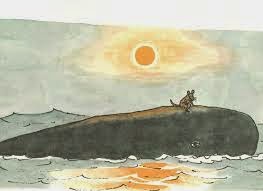
Amos & Boris by William Steig


This book was given to me as a gift by my friend Lolo, who has excellent taste in books, so I knew I was going to love it, but I did not I was going to love it THAT MUCH.

In the story a little mouse named Amos builds a small ship and sails it into the ocean in search of adventures. A few days into the journey as he is laying on the deck of his ship contemplating the meaning of the universe he accidentally falls overboard. He remains alone in the middle of the ocean until he is rescued by a large whale named Boris who delivers Amos back to his home shore. Many years later Boris is beached on Amos's shore and Amos in turn saves Boris's life as he finds a clever way to get him back in the water.


What I love the most about this book is the effortlessness with which Steig takes the reader from considering a tiny mouse in the middle of the ocean ( a very small thing) to contemplating the far reaches of the universe (a very large thing) to true love that can exist between friends (the biggest thing). The book does this very simply and directly, through the text, but also through the wonderful illustrations which reinforce the simplicity behind the complexities of life.

The other thing I love the most about this book is the way that it is written. Steig is unapologetically nerdy, which I think is a huge sign of respect towards his audience. He uses big words that many kids reading the story won't know, but will love anyway. He talks about death, extensively, both when Amos believes that he will drown in the ocean and when Boris is laying dehydrating on the sand, and while no one dies in this story the possibility is there, safe yet terrifying, like real death, considered, anticipated, and accepted. I believe it is extremely important to talk about death to children so that they internalize the concept as being a normal part of existence from the start, and I think this book provides a wonderfully solid bridge to that conversation and to many other great unanswerable questions of existence.


The last thing I love about this book is the way Steig devotes tremendous attention to the spaces of time between big events. There are lots of pages devoted to contemplation (four to be exact that Amos spends floating alone in the middle of the ocean), pages devoted to enumeration (such as a long list of everything Amos loaded onto his boat before sailing it into the ocean), pages devoted to thoughts and feelings that the two friends experienced towards each other as they swam through the ocean. I think a lot us agree that it is the attention to the details in the non-eventful spaces of life that so often get disregarded as unimportant, but those seemingly uneventful spaces really are the meaning of life. This book does a very solid job of reminding its readers of that.

This book can be read on many levels so I am very comfortable recommending it to anyone with a sense of humor, a love of adventure, and an appreciation of wonderful illustrations.

On a personal note, I was trying to read this book to my daughter Miriam while simultaneously translating it into Russian and found the language to be too complex to really do it justice on the fly. So I spend some time with it, and a dictionary, and them my mom Margosha  edited it, so if you read Russian to your children, you can get the book in English and use my Russian translation (see below).


Мышонок Мося жил на берегу океана. Он любил дышать морским воздухом. Он любил слушать, как волны разбиваются о берег и катают по песку камешки.

 Он много думал об океане и о далеких краях на другой стороне воды. И однажды он начал строить кораблик. Он работал над ним днями на пляже, а по ночам он изучал мореходство.

Когда кораблик был закончен, он его нагрузил сыром,  сухарями, желудями, медом, пшеницей, двумя бочками свежей воды, компасом, сектантом, телескопом, пилой, молотком и гвоздями, запасными досками на случай ремонта, иголкой и нитками, чтобы штопать разорванные паруса, и вcякими другими важными вещами, такими, как пластырь, йод, ю-ю и игральные карты.

Шестого сентября, когда море было очень спокойным, Мося дождался, когда прилив почти достал до кораблика, и тогда, используя самую зверскую силу, он сумел столкнуть кораблик в воду, забраться на борт и поставить парус.

Грызун, так назывался кораблик, оказался очень крепким и устойчивым. А Мося, после одного утомительного дня страдания морской болезнью, оказался отменным моряком, очень хорошо подходящим к кораблю.

Мося невероятно наслаждался cвоим путешествием. Стояла прекрасная погода. Днем и ночью он качался вниз и вверх, вниз и вверх по волнам величиной с горы, он был переполнен удивлением, готовностью и любовью к жизни.

Однажды ночью, в фосфорецирующем море он с восторгом наблюдал, как киты пускали  фонтаны фосфорецирующей воды. Лежа на палубе кораблика и созерцая огромное звездное небо, крошечный мышонок Мося, маленькая крошка жизни в бесконечной живой вселенной, чувствовал себя совершенно неотделимой частью мира. Переполненный его таинственной красотой, он несколько раз перевернулся и скатился с палубы своего корабля прямо в море.

 - «Помогите!» - запищал в отчаянии Мося, пытаясь схватиться за Грызуна, но корабль избежал его хватки и уплыл на полных парусах. Больше Мося его не видел.

И где он оказался? – В середине огромного океана, тясячи миль от ближайшего берега. Ничего не было видно, сколько хватало глаз,  и даже ни одной доски, за которую можно было бы ухватиться.- «Может мне попробовать доплыть до дома?» - подумал Мося – «или просто постраться не утонуть?». Он мог проплыть одну милю, но точно не тясячу. Он решил держаться на плаву, плывя на месте и надеясь, что кто-нибудь – но кто? – придет ему на помощь.  А что, если появится акула, или какая-нибудь большая рыба, например, ставрида, - что тогда? Как он будет себя защищать? Он не знал, что делать.

Как это всегда бывает, наступило утро. Мося ужасно устал. Он был очень маленьким, очень замерзшим, очень мокрым и испуганным мышонком. Вокруг ничего не было, кроме открытого моря. И тогда, когда казалось, что хуже быть уже не может, пошел дождь.
Наконец-то дождь кончился, и полуденное солнце прибавило ему немножко бодрости и тепла в безбрежном одиночестве, но у него почти кончились силы. Он стал думать о том, что может утонуть. А если он утонет, сколько времени это займет? Это будет больно? А его душа полетит в рай? Там будут другие мыши?

Пока он задавал себе эти страшные вопросы, огромная голова разбила поверхногсть воды и нависла над ним. Это был кит.
- А что ты за рыба? – Спросил кит. – ты, наверное, единственный в своем роде?
 - Я не рыба – сказал Мося, - я мышонок, я млекопитающеее, высшая форма жизни. Я живу на земле.
 - Святые моллюски и каракатицы! – сказал кит, - я тоже млекопитающий, хотя живу в море. И добавил – можешь звать меня Борей.

Мося представился и рассказал Боре, как он оказался посредине океана. Кит сказал, что он с радостью отвезет Мосю на Берег Слоновой Кости, куда он и так плывет на встречу китов со всех семи океанов. Но Мося сказал, что ему надолго хватит приключений. Он хотел только поплыть домой, и надеялся, что кит не возразит сделать крюк и отвезти его туда.

 - Я не только не буду возражать,  - сказал Боря – я сочту это за честь .
 - У какого еще кита во всем мире будет возможность познакомиться с таким странным существом как ты!
 - Прошу на борт! И Мося забрался на борину спину.
 - Ты уверен, что ты млекопитающее? – спросил Мося – от тебя пахнет больше рыбой.  И кит Боря поплыл с м ышонком Мосей на спине.

Какое облегчение опять быть вне опасности, в сохранности! Измочаленный Мося прилег на солнышке и вскоре уснул.

И вдруг он опять оказался в воде, плескаясь и захлебываясь! Боря на секунду забыл, что у него на спине ехал пассажир, и нырнул. Когда он осознал свою ошибку, он всплыл на поверхность так быстро, что Мося полетел кувырком, хвост через усы, по воздуху.
Мося больно ударился об воду! Безумный и очумелый от ярости он вопил и колотил Борю кулаками, пока не вспомнил, что обязан киту своей жизнью, и тихонько забрался обратно на спину. Однако, с этой поры, когда Боре нужно было нырнуть, он предупреждал Мосю заранее, и, получив соглашение, нырял, пока Мося плавал.

Они плыли когда с большой скоростью, когда спокойно и неторопливо, иногда останавливаясь, чтобы обсудить идеи,  иногда – чтобы поспать, и у них заняло неделю, чтобы достичь берег мосиного дома. За это время они прониклись к друг другу глубоким уважением. Боря восхищался нежностью, трепетным изяществом, легким подходом, тонким голосом и как будто жемчужным сиянием мышонка. Мося восхищался объемом, величием, мощностью, целеустремленностью, обильным голосом и большим количеством дружелюбия кита.

Они стали ближайшими друзьями. Они рассказали друг другу о своих жизнях, амбициях, Они делились самыми глубокими секретами друг с другом. Киту было очень любопытно узнать про жизнь на земле и грустно, что он никогда не сможет там пожить. Мося был зачарован докладами кита о том, что происходит глубоко под морем. Мося иногда наслаждался бегом туда и обратно по китовой спине.  Это было необходимым упражнением для мышонка. Когда он был голоден, он ел планктон. Единственное, чего ему не хватало, это свежей пресной воды.

Но пришло время прощаться. Они были возле берега. - Я бы хотел навсегда остаться с тобой друзьями, сказал Боря.  – Мы, конечно, останемся друзьями навсегда, но мы не можем быть вместе. Ты должен жить на суше, а я в воде. Но я тебя никогда не забуду!
 -   А ты можешь быть уверен, что я никогда не забуду тебя! - сказал Мося.  – Я всегда буду тебе благодарен за то, что ты спас мне жизнь, и помни, что если тебе когда-нибудь понадобится моя помощь, я буду счастлив тебе ее предоставить!
Мося не мог себе представить, как бы он мог помочь Боре, но он сильно чувствовал свою готовность.
Кит не мог довести Мосю до самого берега.  Они пропрощались в последний раз, Мося спрыгнул с бориной спины и поплыл к берегу.

Стоя на вершине скалы он смотрел, как Боря два раза брызнул фонтаном и исчез из виду.
Боря сам себе посмеивался – как же маленький мышонок может мне помочь? Правда, он хотя и маленький, но у него отважное сердце! Я его люблю и буду ужасно по нему скучать!
Боря сплавал на конференцию возле Берега Слоновой кости в Африке и вернулся к своей привычной китовой жизни. А Мося вернулся к своей обычной мышиной жизни. И оба были рады.

Прошло много лет после сверхописанных событий, и когда Мося был уже не очень молодым  мышонком, а Боря не очень молодым китом, поднялась одна из самых ужасных бурь века, ураган Этта, и так оно случилось, что огромная приливная волна вышвырнула кита Борю из воды на тот самый берег, на котором жил Мося.  

И так оно еще было, что когда буря стихла, а Боря остался лежать на высоком и крутом берегу, теряя влажность на горячем солнце и страстно желая опять попасть в воду, Мося спустился на пляж проверить, сколько Этта нанесла ущерба.
Разумеется, Мося и Боря моментально друг друга узнали. Я могу тебе не рассказывать, что эти два друга почувствовали при встрече в такой безвыходной ситуации. Мося бросился к Боре, а Боря мог только смотреть на Мосю.

 - Мося, помоги мне, - сказала гора  кита пылинке мышонку, - я думаю, что умру, если скоро не попаду обратно в воду. Мося смотрел на Борю с состраданием и жалостью. Он понял, что надо быстро действовать и срочно придумывать, что делать. И вдруг он исчез.
- Я боюсь, он не сможет мне помочь, - сказал Боря сам себе. – Как бы ему ни хотелось, что может сделать такой маленький парнишка?

Лежа в одиночестве на берегу Боря чувствовал все то же самое, что испытал Мося в середине океана. Он был уверен, что он умрет. Но когда он начал готовится к смерти, примчался Мося с двумя самыми большими слонами, которых он смог найти.

Не теряя времени, эти два добродушных слона начали изо всех сил пихать борино огромное туловище, пока он не начал переворачиваться, извалянный в песке, и катиться к морю. Мося, стоя на голове одного из слонов, выкрикивал инструкции, но его никто не слышал.

 В течение нескольких минут Боря был уже в воде. Волны окатывали его и он чувствовал прекрасную влагу.
 - Нужно оказаться вне моря, чтобы по настоящему понять, как хорошо быть в море – подумал Боря.
 - Если ты кит, разумеется.
И скоро он смог сам протиснуться и пропихнуться дальше и глубже в воду.

Он повернулся и посмотрел на Мoсю, сидящего не слоновой голове. По щекам огромного кита текли слезы.  У крошечного мышонка тоже были в глазах слезы.
 - Прощай, друг – пропищал Мося.
 - Прощай дорогой друг – прогудел Боря и исчез в волнах.
Оба они знали, что никогда друг-друга не забудут.


Конец


Friday, March 28, 2014

I'll Be You And You Be Me by Ruth Krauss and Maurice Sendak


I've been thinking how I should write about this book for a long time. It's very hard, because when I hold it in my hands and leaf through the pages, I feel like there's a waterfall of love that engages my whole body in pure joy and connects me to the source of all things good, all things directly related to sunshine, wonder and life. But as usual, that leads to me writing about my own feelings about it rather than about the book itself; so having gotten that out of the way, I'll try to describe why this book is the best ever.


Each page is a different distillation of the experience of childhood into words and illustrations at the highest level of poetic purity. Each page is about a different way to experience love. Each page is about a very very very simple way to experience the universe in an intimate and meaningful way through other people.


Ruth Krauss writes very much like a child might talk, but not in a way that most adults infantilize children. The writing is absolutely respectful, kind, and honest. She is clearly somebody who took children and their existence extremely seriously - and this book is a real testament to that. She explains things through dialogues and interactions between characters and Maurice Sendak offers his illustrations as possibly ways to play with her words and thoughts.


Collaborations between creative geniuses can either lead to disaster or genius, and this book is a testament to the latter. One of my favorite things about the illustrations is that these were done well before Sendak was famous; this is well before Wild Things  - this is the third book he ever illustrated. I am always so overwhelmed with the ease and the grace with which he makes the essence of childhood accessible to humanity; This is something that I too try to do with my life, and I know how amazingly difficult this is.


I am ok if people don't read this book until they grow up. As I have mentioned I don't believe that books should ever be allocated for a particular age group - any book can be smelled, and held, and leafed through, and admired and wondered about at any age. Children can look at a page in a dictionary and experience the placement of small black marks on a page that will affect, and relate to, and create a memory of things we could never teach and explain to them in words. And adults can read a book like I'l be You and You Be Me really feel what it was like to have been, and to be a child in a way that even playing with their own children won't make them feel.


Saturday, July 20, 2013

Wave by Suzy Lee


There are three kinds of children's books I hate the most. One, are the children's books written by celebrities. Two, are children's books that teach an important life lesson with a heavy moral. And three, are children's books in which the illustrator uses some sort of a crafty technique to create the illustrations, aiming for grand effect that lasts exactly a second until the viewers get bored  out of their minds because the lack of  deliberate details translates directly into a lack of visual information that makes the pictures stupid and uninteresting. Children pick up on this much faster than adults, but even some grown-ups can be taught to look through the pizzaz. One of the worst offenders of this artistic crime is this guy who could be great if he stopped bullshitting (as he did for the The Tale of Despereaux), but his drawings tend to be emotionally and technically ambiguous in a way I really don't like.

This entry, however, is not about him, but about an exceptional book that uses a crafty technique and teaches a valuable lesson, and nevertheless happens to be one of my favorite picture books of all times.
Wave is a book that explores the ancient theme of "man vs. nature", where the "man" happens to be a little girl, and "nature" happens to be the ocean, on one of whose beaches the little girl finds herself, for what looks like the first time.

The story is told in pictures only, no words. However, since the author/illustrator Suzy Lee can actually draw, a skill so many contemporary illustrators profoundly lack, the narrative is exceptionally clear, nuanced, and complex. The pages are split so that the little girl and her seagull entourage are on the left page, and the ocean is on the right up until both parties brave the unknown and venture onto each other's territories with wonderfully joyous and exciting results.

The illustrations are a done in pencil for the girl and the seagulls, and a blue watercolor(?) resist wash which makes the wave and the ocean simply beautiful and very accessible for children. The way the interplay is set up between the two pages is comparable to the use of image size and page spillover in the Wild Things, which is probably the highest compliment of a comparison one could make towards a picture book.

One of my other favorite things about Wave, is that there is a real sense of danger in the story. The mom, who we see on the title page bringing her little girl to the beach, sits under her umbrella in a space off the edge of the page, so that we only see the girl alone. The ocean is much larger than the girl, and the wave reaches well above her head when it comes, and on one of the page when the wave comes over onto the girl's half of the book, it covers the girl entirely. I like this honesty and sense of risk that you feel when reading the story. I am glad everyone is ok, and as the wave retracts back into the ocean it leaves sea treasures for the little girl to play with, but I also like that something scary must be overcome before comfort and understanding can be achieved. I love the fact that many of the implications of this story can never really be articulated in words. 

I have been wholeheartedly recommending this book to my friends for many years now (as well as the other Suzy Lee books about which I will most certainly write very soon), but having my own little girl who has been playing on the beach and encountering the waves has made me appreciate this book on a whole new level.


Monday, May 27, 2013

Excellent Board Books or...

Books My Daughter Likes To Eat Read!
This post is dedicated to Miriam as she nears her first birthday.


This post will be a little different, and concerns a few board books that I have found particularly pleasant to interact with in the first year of my daughter's life. I know that some of these books exist as regular books and not sturdy little blocks that are so great for munching on and testing gravity with, but for the purposes of this post I am refer to the board book versions. Also, while I am largely expressing my opinions here, I am very much taking into account Miriam's responsiveness to the books, as my opinions have been at least in part affected my her reactions.


1: Mon Cirque by Xavier Deneux


I got this book at the overpriced gift shop at the Boston Museum of Fine Arts but have never regretted it. The book is absolutely wonderful. The red-yellow-and-white illustrations against mostly black backgrounds are bright and extremely clear, which is exactly what excites babies and keeps their attention. Each page has one or two cut-outs in it - small holes and big ones, in all different shapes, through which one can peek, stick a hand, pass a small object, or simply trace the outline of the cut-out with a little finger. Each page tells us about some aspect of the circus - and what is most excellent, it does so in french, so you can learn important french words like the ones for tight rope walker and clown. Mon Cirque has a wonderfully wild energy about it - it actually feels like you are in the circus when reading it. It is playful, and strange, and aloft, and mysterious and distant and exhilarating at the same time. The cut outs are extremely clever, some go as far as three or four pages deep, but each page uses the back image for it's own purposes; for example a zebra becomes the pants of a tight rope walker who then becomes a juggler with another turn of a page. This is a book I can definitely appreciate without the assistance of a baby, but thankfully the baby inherited my excellent taste so we can appreciate it together for long periods of time.

2. Goodnight Gorilla by Peggy Rathmann


This book is one of my all-time favorites. A lot of people snort at it because they think it is a rip-off from Good Night Moon, but please believe me, it has nothing to do with that other book, praise the Lord. In Goodnight Moon the zookeeper walks around to all the cages in the zoo saying goodnight to all the animals, while unbeknownst to him the Gorilla has snatched his keys and is following him around setting all the animals free. They join the queue behind the gorilla, follow the zookeeper out of the zoo, into his house which is just across the lawn, into his house, and into his bedroom, and they all settle in there, with gorilla in the bed, between the zookeeper and his wife. And then the zookeeper's wife says: "goodnight!" and all the animals say: "goodnight!" and the wife gets up and walk the animals back to the zoo until the sneaky gorilla spoils the plans of the humans yet again in the most wonderful and coziest of ways.

This book is wonderful because the details are full of love and kindness in that special way that is fairly rare in the world. There are practically no words, so you can tell the story in whichever way you like - and in whichever language, which is applicable in our case.


3. The Hungry Little Caterpillar by Eric Carle


There isn't much that is left to be said about this book as it has probably outsold the bible and the collected works of Shakespeare a few times over, and has been translated into as many languages, but I do have something to say. What I have to say, is that I have a very negative opinion of Eric Carle. I think he is the biggest charlatan out there, who, through sheer luck stumbled upon a winning technique and has been milking it for decades. While I agree that his stuff is still better than a lot of children's literature out there, there a notable lack of humor in everything Carle does that I believe to be incompatible with great children's books. Eric Carle is a bit too heavy as a human being to dance his ideas around and I believe that makes them inflexible, soulless, though that might be too harsh or a word, and unable to be loved. I don't understand how any of his characters can truly be loved by children or grown-ups, because they never evolve beyond flat paper cut-outs.
And yet, The Hungry Little Caterpillar is a fantastic book. It is like a poem, in which everything is perfectly arranged, and all the information and meaning is conveyed through the smallest possible number of words and pictures. It is a wonderful book to read with a child, who can stick a little finger into all the holes on the pages, and count the fruits and the other foods it eats throughout the journey. Despite everything that goes on in the book, there is a certain calm to it, a pace, a rationality, a sequence; that makes it possible to read over and over and over again and never really get bored with it.

4. A Color Of His Own by Leo Lionni


While Leo Lionni's art could, and has been compared to Eric Carle's, I think they are as far apart as two artists could be. Lionni's protagonists are also colorful, often collaged beasties, but they are wonderful, loveable, diverse, unique, and evolving.

In a Color of His Own a little chameleon has a hard time with not having a permanent color. He tries to sit on different things but the world is always changing, and no color gets stuck. A green leaf turns yellow and red and falls off a tree altogether, taking little chameleon with it, until, in the end, the chameleon accepts his fate with the help of a friend in the same predicament; because things that are complicated about one's life are always better when you can do them with a friend.

I also love this book because the story is unpredictable and spontaneous. It starts out by pointing out over a few pages that regular animals have a personal color that belongs to them, so it looks like a book about animal colors, and then you are  surprised by the appearance of the chameleon and his predicament. And one my favorite things is that at least twice in the book the chameleon sits on a tiger and turns tiger color. So you learn about tiger colors without being explicitly told what they are. You never fully see the tiger - only a part of it, with a striped chameleon. I think it is that kind of brilliant subtlety that sets Leo Lionni and his book apart from some other writers. At the end. both chameleons sit on one of those red mushrooms with white polka dots and turn polka dot color. It is all very clever, and creative, and truly wonderful and lovable.


Sunday, April 28, 2013

3 Wishes for Pugman by Sebastian Meschenmoser


http://www.wilkinsfarago.com.au/images/9780980607093.jpg


I've been waiting to write about this book in the same way I used to anticipate my birthday as a child: with a giant bubble of joy that quietly sits in the stomach somewhere nudging the heart once in a while, knowing something truly wonderful is out there,  does not happen very often, but is entirely real.

3 Wishes for Pugman  by the children's-book-writer-illustrator-love-of-my-life S. Meschenmoser is about a depressive dog who lives in a large dog house with a living room and a kitchen and a hallway and art on the walls and other comforts of a nice home. One morning he wakes up at a time of day when one might seriously consider pulling the blankets back over one's head and trying to sleep straight into the next day, but instead he gets up, pulls on his bathrobe, and slowly walks into the kitchen to discover that he is out out of cereal, and coffee, and it's pouring rain outside, and the newspaper is soaked through, and at this point you can probably imagine how he is feeling, especially since he is obviously a PUG and we all know how challenging it is to be one of those in the first place. As Pugman is sitting on the floor contemplating his miserable life, a fairy suddenly appears and offers him three wishes. Whether he takes her up on her offer and what the wishes are if he does, you will really have to find out by reading the book, and I will instead offer my opinions as to why this book is awesome.

First of all, as I had mentioned in my other post where a book by this author was reviewed,  there is simply no better artist illustrating children's books at this point in time. Pugman surpasses the level of artistic brilliance set by Learning to Fly; the pencil strokes are looser, more playful, more spontaneous, and convey a new level of mastery.  There is also such a world of love for each little pencil stroke and hint of color, and so much kindness in every image that at least for me the book must be read in intervals of a few days because I go into sensory overload from both the visual information and the intense kindness of the narrative and it takes a while to process it all.

Second, similar to Learning to Fly, 3 Wishes for Pugman is a children's book that mercifully does not have any child characters or naive animal characters that children's books are apparently compelled to contain nowadays. Pugman is clearly an adult, with an adult life and adult problems and I think that very fact makes it incredibly valuable for children to read this book - it says that grown up life can be hard and unpredictable too, and does so in a respectful, gentle way. Additionally, when the fairy shows up, she is portrayed in such a vulgar, obscene and invasive way, that the hearts of those of us who hate all the tasteless, Disneyfied, dumbed down, soulless crap that the world of childhood has been infested by, our hearts rejoice and feel validated in a whole new way whether that was the author's intention or not. The super bright colors and the grotesque objects that are paraded by the fairy in an attempt to seduce Pugman into making wishes are in such strong contrast to the depressive, but subtle and tasteful images of the first half of the book that they are hard to look at. I think that by employing a drastic change in the style of the pictures halfway through the book, Meschenmoser makes the strongest commentary on the horrifying reality of children's literature (and, I would argue other forms of child entertainment) to date. Not even Sendak could say it like that, however scathing and sarcastic his remarks were in the last fifteen years or so. However, commentary aside, Meschenmoser seems to possess a Miyazakian quality not to divide his characters into the good and the bad, but to see the wonder, the magic, and potential in every situation, and to make the best of things, which is exactly what Pugman does with his wishes (and, I would say, Meschenmoser with his books).


Before I sign off, as a little bonus, I would like to mention that 3 Wishes for Pugman has a spectacular sequel, that I only have in German, called Mopsmanns Magische Wunderwolle, (or La laine magique de Molosse in French, in which it is also apperently available, though not in English yet, as far as I can tell. Just as, if not even more wonderful than the first one, I recommend getting this in whatever language, the pictures tell the story better than any words ever will.


 t

Monday, April 1, 2013

How I Learned Geography by Uri Shulevitz

  Uri Shulevitz is a hard person for me to write about  because he has written and/or illustrated a very large number of books about which I have drastically different opinions, but I'll just focus on this one. I think this is by far the best book Shulevitz has written.

How I Learned Geography is an autobiographical story from the time when Shulevitz was a little boy. His home in Warsaw was bombed during the war, and his family escaped to Kazakhstan where they survived. While in Kazakhstan they had very little money for food, and one day his father went off to the market to buy bread, and instead spent all the food money on an enormous map of the world. The family went to bed hungry, listening to the neighbors eat their bread, but the next day, the map went up on the wall, and little Uri discovered the magic and the salvation offered by this new object. He started to "travel" all over the world in his imagination, making up poems from all the strange names on the map, drawing parts of the map on precious bits of paper that came his way, and in many ways using this object as a means of surviving starvation, loneliness and uncertainty.

The first big reason I love this book is because I love maps most of all. I don't know if I would have had the strength to buy a map instead of food if I was in the father's place, but I certainly would hope so. There is something so profoundly familiar in this act, I feel like the characters in the book are a part of my family.

The second reason I love this book is because it deals with WWII and indirectly with the Holocaust (Shulevitz is Jewish, of course) in a very subtle, personal and honest way, without using those two events to blow up one's self-importantce, in way that most books, movies, poems and art works by people not connected to the events do. This is why I generally refuse to have anything to do with them, and find the activity of using the Holocaust to promote one's art or writing truly appalling, a cheap and indecent way to get extra points without making the work good in it's own right. This book is one of the few exceptions to this phenomenon that I have seen, and I very much respect Shulevitz for talking about his experiences in the way that he does, as someone who actually experienced it, not someone who merely observed and was "affected".

Third, both the text and the pictures are superb. In my opinion Shulevitz has often unsuccessfully tried to be poetic with his texts which made his stories boring and meaningless, and it is definitely not the case with this story. Probably because he is actually describing real events, the plot is strong and well structured, and he is very successful at using a few words to convey a lot of meaning. The illustrations are also some of his strongest. Maybe because he is going back to the place of his childhood imagination, and also visually recalling childhood memories, the pictures are exciting, emotional, diverse, dynamic, colorful and engaging.

My last and most favorite part of this book is the very last page, the one that comes after the story is over. On that page there is an autobiographical note describing the actual events on which the story is based, a photograph of a map Shulevitz drew as a child on the back a letter, a comic he drew as a teenager when after the war the family lived in Paris, and, a photo of Shilevitz as a little boy. I especially appreciate the photo of the author as a child, as that puts the book into an elect group of examples of children's literature that touches on the idea that adults and children do not necessary need to exist in two different and separate worlds. The other two books that are quite dear to me,  include the Little Prince with its dedication to Leon Werth (friend of the author) when he was a little boy, and Korczak's King Matt the First, with a photo of Korczak  as a boy on the first page.

This is a special and important book for grown-ups that used to be children, and for children who plan to become good grown-ups.